Capturing What We Can
As winter approaches, cherished family traditions remind us to slow down, nourish our bodies, and preserve what matters most: love, connection, rest, and the wisdom passed down through generations.
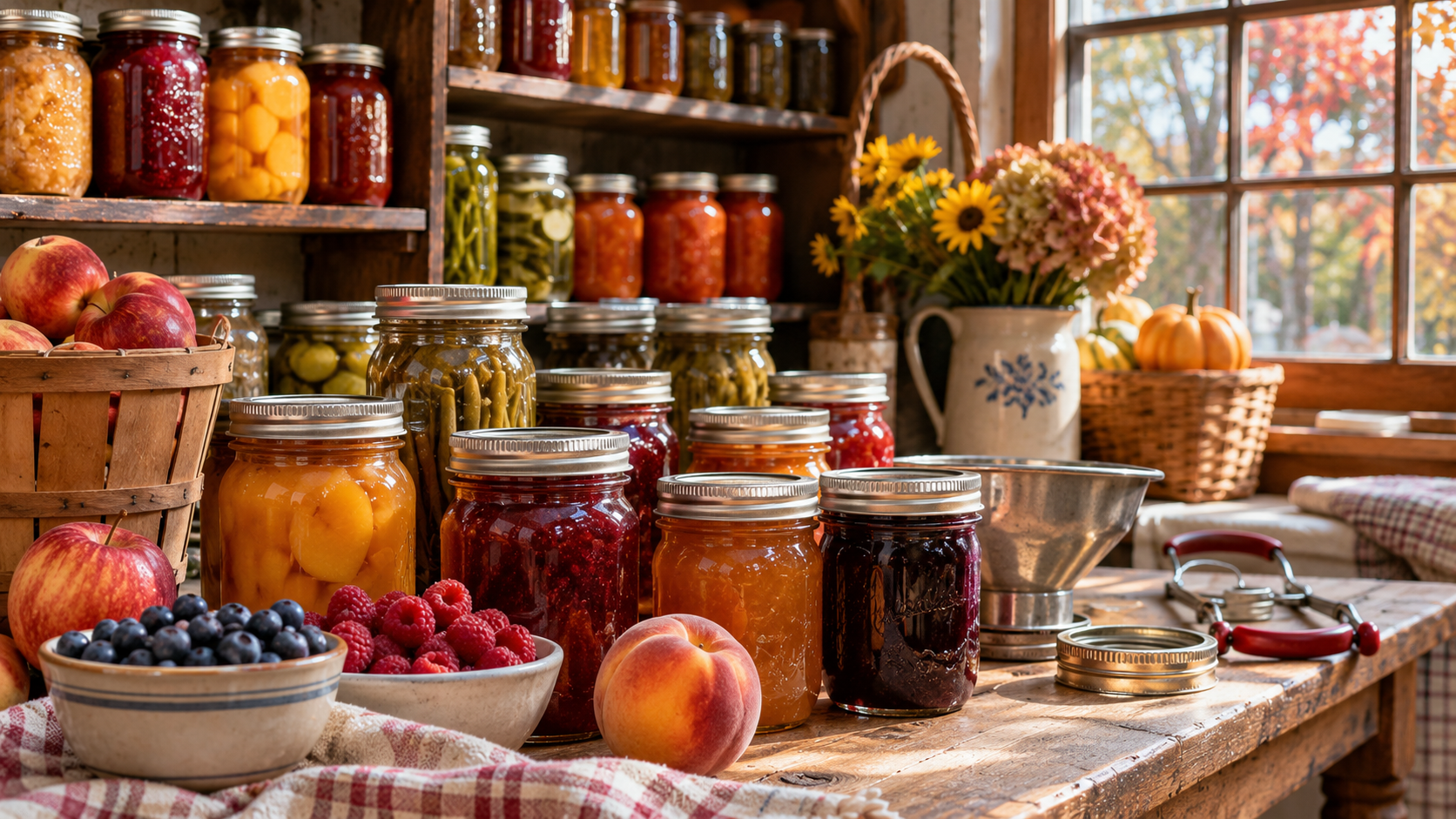
Gearing Up for Winter With a Pantry, a Little Hibernation, and a Touch of My Grandparents
By Rachel Y. Hill, DNP, FNP-BC, PMHNP-BC, AHN-BC, HWNC-BC
The leaves are down, the evenings are dark, and something in me has started to slow.
I notice it every year around this time.
I want soup. I want blankets. I want to be home earlier and stay there longer.
That's not laziness. That's the season calling.
Animals have always known what to do when winter comes. They gather, they store, and then they rest.
We humans have a harder time listening, because the modern world keeps asking us to run at summer speed all year long.
But I have been thinking about how my grandparents would have heard that call, and what they did about it.
What My Grandparents Knew
My grandparents still kept a garden, and they would can what they grew.
They made preserves for the winter during the summer, and did all the things that go along with it.
When the harvest was plentiful, they captured it, so that when the cold came and the ground was bare, there would still be something good on the shelf.
Later, when city markets came along, they started buying up enough of the produce to can it, making jellies and jams.
I still remember when the groceries were closed on the weekends, and we would turn to the preserves.
That was so long ago.
I think about that a lot now.
There was a wisdom in it that went beyond food.
They understood that you can't wait until you're in need to start preparing.
You gather while the gathering is good. You put something by for the lean months.
I'll confess something: I missed my canning window this year.
The summer got away from me, as summers do.
But I've made peace with it, because I've realized something about myself.
I love to capture what I can, when I can.
It doesn't have to be a whole season's harvest.
It can be a batch of this, a jar of that, a handful of good things set aside.
Whatever I can catch, I catch.
Was It Made With Love?
Now we can get nearly anything, anytime.
The grocery store is open, the shelves are full, and strawberries show up in January.
I'm grateful for that convenience, and I don't take it for granted.
But the question I find myself asking is this:
What was it made with?
Not the ingredients on the label.
I mean the love.
Hmmm? Not like my grandparents, right?
When my grandparents put up a jar of jam, there were hands in it.
Time, attention, a whole afternoon in a hot kitchen, and a person who was thinking about the family who would eat it months later.
Every jar was made for someone.
It's hard to put that on a nutrition label, but I believe we can taste it.
I'm not saying everything from a store is loveless, or that everyone has time to can.
Most of us don't, and that's okay.
People who work long shifts and raise families are making love out of whatever they can manage.
But I do think it's worth asking where the love is in what we put into our bodies, and how much of it we can bring back.
A pot of soup made slowly.
A jar of syrup stirred by hand.
Even a simple meal made on purpose for someone you care about.
My Winter Pantry
So here is what's in my kitchen as winter arrives.
Homemade Kombucha
I'm making my own kombucha.
Fermenting it, tending it, tasting it.
There's something satisfying about a bubbling jar on the counter, a small living thing that I'm looking after.
Apple Cider Vinegar
I'm making my own apple cider vinegar, and all that goodness for my health and wellness.
Honey Cough Syrup Remedies
And I make my own honey cough syrup remedies, which have always been what the doctor ordered.
(And as someone who is, in fact, the doctor, I'm allowed to say that.)
What I love most is this: no matter how much medicine is stocked on the shelves at CVS, my own kitchen pantry has a touch of my grandparents right there.
When I open a cabinet and see my own jars, I feel connected to the people who taught me that you take care of your people with what you have, and what you've put by.
It's a kind of inheritance, and no pharmacy can sell it.
How Could They Have Known?
Here's the question that keeps me curious.
How did our ancestors know?
How did someone, generations ago, figure out that honey, onion, ginger, and garlic were good for you when you were sick?
There were no laboratories.
There were no clinical trials.
There was no internet to look it up.
Think about how that knowledge must have been built.
Someone felt a cough and reached for something sweet and soothing.
Someone noticed that the kitchen's strongest, sharpest ingredients seemed to help when the body was fighting something.
Somebody tried it, somebody else tried it, and the family kept doing what seemed to work.
Then they told their children.
Over many generations, they were running the longest-running experiment in history, with observation as their only instrument.
And what's remarkable is that some of that old magic turns out to be scientific.
Honey: When Tradition Meets Research
Honey is the best example.
A Cochrane systematic review of honey for acute cough in children, which combined six randomized trials with 899 children, found that honey probably relieves cough and reduces its impact on sleep better than no treatment, and may even do better than a common antihistamine.
The researchers did note that evidence quality was low to moderate and that most children got honey for just one night, so it isn't the last word.
But it is a nice moment when the lab catches up with grandma's kitchen.
Garlic: A More Complicated Picture
Garlic is more mixed, and I want to be honest about that.
It contains a compound called allicin that shows antimicrobial activity in laboratory settings, but a Cochrane review found insufficient clinical trial evidence that garlic prevents or treats the common cold.
One trial suggested fewer colds with a garlic supplement, but more studies are needed.
Ginger and Onion: Honoring Tradition With Curiosity
Ginger and onion have long histories in kitchens and traditional remedies around the world.
I haven't gone through the research on them for this post, so I won't make claims either way.
I would just say that being old doesn't automatically make something true, and being old doesn't make it false either.
That's the balance I try to hold.
I honor the tradition, and I stay curious about the evidence.
Some of what was passed down holds up beautifully, some of it is comforting even where the data is thin, and some of it needs updating.
Respecting our ancestors doesn't mean never asking questions. It means we do their work justice by continuing to learn.
A Little Common Sense for the Kitchen
I'd be a poor nurse if I shared all this and didn't add a few words of care.
Homemade doesn't mean risk-free, and the wisdom of the old days included knowing what to be careful with.
- Honey and babies. Never give honey to a baby under 12 months. Their immune systems and guts aren't ready for the bacteria that may be present, and it can cause serious illness. It's for older kids and adults only.
- Apple cider vinegar. It's acidic, and drinking it straight can wear down tooth enamel. Dilute it well, and rinse your mouth with water afterward.
- Homemade kombucha. Clean everything carefully, and be thoughtful about your containers. Poison control sources have documented cases of lead poisoning when kombucha was brewed in ceramic containers, since it's acidic. They also advise that young children, pregnant women, and people with weakened immune systems skip kombucha altogether. If your batch looks, smells, or tastes wrong, or shows mold, throw it out.
- When to see someone. A remedy is for comfort and support. A fever that won't break, trouble breathing, a cough that lingers for weeks, or anything that worries you deserves a visit to your provider. Kitchen medicine and modern medicine are partners, not rivals.
Preserving More Than Food
As I've been thinking about all of this, I've realized that gearing up for winter isn't only about the pantry.
It's about capturing whatever we can to carry us through the dark months.
Here is how I'm trying to put things by.
- Light. We lose it, so we protect what we have. A morning walk when the sun is up. Candles in the evening. A lamp near the favorite chair.
- Rest. Winter is a natural time to slow down. I'm giving myself permission to sleep a little more and to say no to a little more.
- Warmth. Soups, teas, blankets, and the honey-and-ginger kind of comfort that goes down like a hug.
- People. Winter pulls us inward, so I'm scheduling the visits and the calls before I feel like it. Sharing a table, a pot of something good, a story.
- Joy. The music, the dance, the craft, the small things that keep a spirit lit when the days are short.
- Stories. The recipes, the sayings, the stories my grandparents handed down. If I don't pass them on, they disappear. So I tell them, I cook them, I write them down.
None of it needs to be perfect.
I missed my canning window, and the world did not end.
We capture what we can, when we can.
One Last Thing
There is a quiet kind of love in preparing for someone else's hard season.
My grandparents canned in summer for a winter they knew was coming.
In a way, they were taking care of the people they would be in the cold months, and of everyone at their table.
I want to do the same, for my family, for my community, and for the version of me who will need something good on a gray February day.
So as the days shorten, I hope you'll gather what you can.
Jar something.
Brew something.
Call someone.
Light a candle.
Put something good by.
And when the cold comes, you'll open the cabinet and find a little of summer waiting for you, and a little of the people who loved you into being.
Reflection Questions
- What did the people who raised you do to prepare for winter, and what do you remember about it?
- What remedy, recipe, or saying was handed down to you, and who gave it?
- What is one thing you could "put by" this season: a jar, a habit, a person, a little rest?
- Where do you need to slow down as the days get shorter?
- What would you like to pass on to the next generation?
--Dr. Rachel
This post is part of the Wisdom & Wellness Blog. It is shared for education and reflection and is not a substitute for medical care. Talk with your health care provider before using home remedies, especially for children, during pregnancy, or if you have a chronic condition or a weakened immune system.
A Note on Sources
- Oduwole, O., Udoh, E. E., Oyo-Ita, A., & Meremikwu, M. M. (2018). Honey for acute cough in children. Cochrane Database of Systematic Reviews, 2018(4), CD007094. (Six randomized trials, 899 children aged 12 months to 18 years; the review advises against honey for infants up to 12 months.)
- Garlic for the common cold. Cochrane Database of Systematic Reviews (2014 update). (Authors concluded there is insufficient clinical trial evidence; one trial of 146 participants suggested fewer colds with a garlic supplement.)
- Kombucha safety: National Capital Poison Center, "Kombucha Tea: Health Tonic or Dangerous?" (poison.org), which describes lead poisoning associated with brewing in ceramic containers and advises young children, pregnant women, and people with compromised immune systems to avoid it.
- Apple cider vinegar and tooth enamel: summarized from GoodRx's article citing American Dental Association guidance that prolonged vinegar contact can erode enamel.
- I did not research ginger or onion for this post. The accounts of how my grandparents lived and prepared are drawn from your own words; I added no specific details about them.