When Sound Becomes Medicine
Sound can reach places words cannot. Through music, breath, and gentle vibration, we can soften, reconnect with the body, and create space for calm, healing, and reflection.
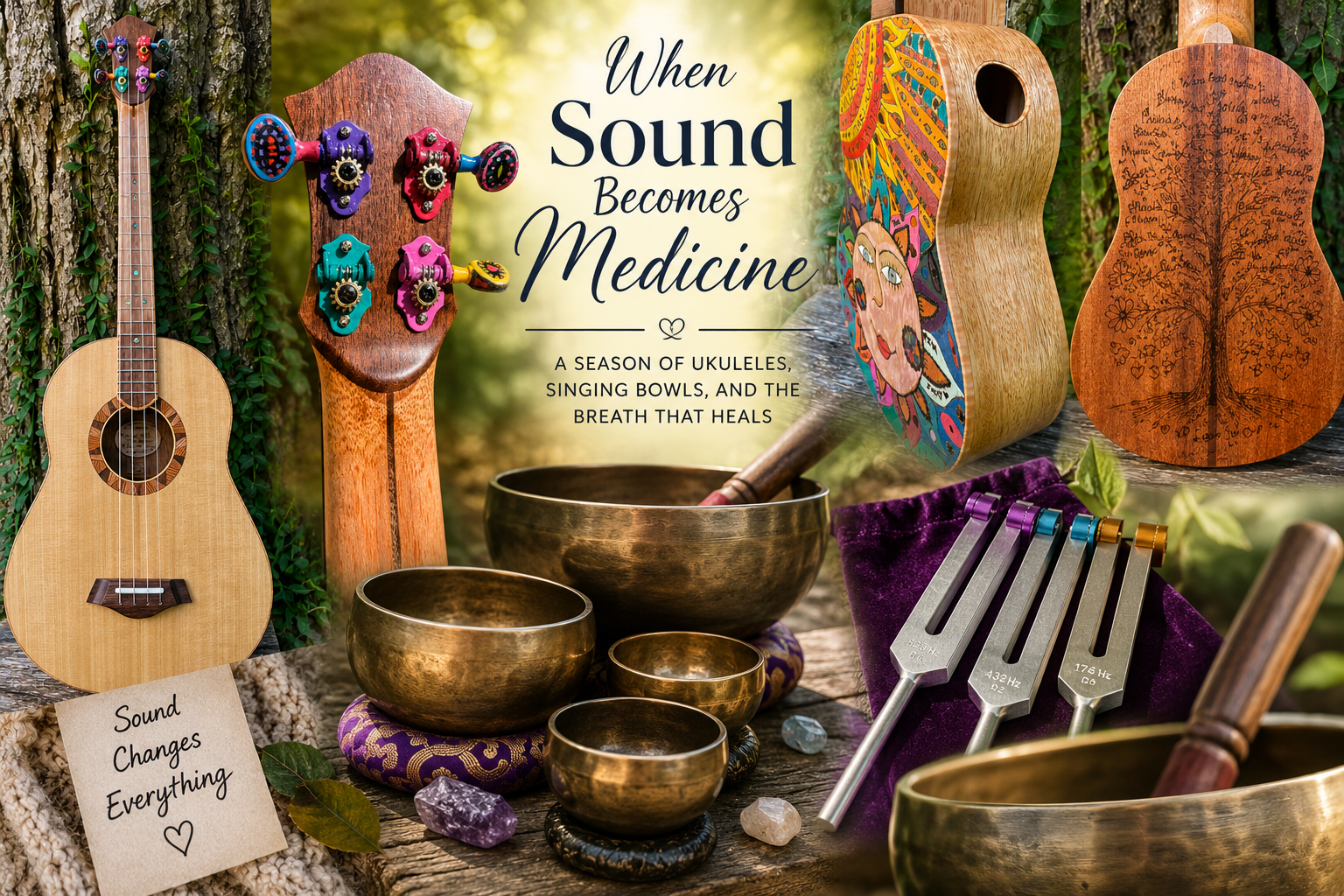
A Season of Ukuleles, Singing Bowls, and the Breath That Heals
By Rachel Y. Hill, DNP, FNP-BC, PMHNP-BC, AHN-BC, HWNC-BC
I was in the middle of writing about the first day of fall—the light changing, the year turning toward its quieter half—when I realized I couldn't get there honestly without stopping to tell you about the season I'm actually in right now.
Not autumn.
Music.
It crept up on me the way real shifts usually do.
Sideways.
Uninvited.
And then suddenly everywhere.
I've played ukulele as a hobby for almost six years now, but a few months ago, I started building a new one with my friend Kelly Stillfield.
Somewhere in that process, I bought a set of singing bowls from a little shop called The Energy Within.
Then came the tuning forks.
And somewhere in the space between all three, I started noticing something I couldn't unnotice:
Sound changes the room.
It changes the body.
It changes me.
Every day, I'm more convinced that the breath and the sound are doing something together that neither one can do alone.
I want to tell you about the instruments themselves because they've become teachers in their own right.
And I want to tell you honestly about what the research does—and doesn't—say about the practices built around them.
Because wonder and rigor aren't enemies.
They can sit in the same room.
Frank, and the Tree He Came From
The ukulele Kelly and I built came from wood harvested from a tree over two hundred years old.
Locally, it was known as the Liberty Tree.
The kind of tree whose age makes you go quiet for a second when you learn it.
That tree almost didn't survive to become anything at all.
It was struck by lightning.
Termites moved in afterward, working at what the lightning had already weakened.
But it was rescued before it could be lost completely.
Saved specifically so that something more than firewood could come from two centuries of standing.
We call the tree Frank.
And now that the wood has become an instrument, it carries that name forward:
Sir Madam Francis Frank.
I love that name more than I probably should.
It holds both the masculine and feminine at once.
Sir and Madam in the same breath.
Francis and Frank folded into a single name.
A tree that survived lightning, termites, and two hundred years of weather doesn't need to pick a single identity.
And neither, it turns out, does the instrument made from it.
When an Instrument Carries More Than Music
But the part of Frank that means the most to me isn't the tree's history.
It's the back of the instrument.
I got to design that part myself.
And I chose to fill it with artwork expressing my love for all my grandchildren—every one of them, including the grandchild who has passed on to heaven.
There's something I can't fully put into words about that choice.
A tree that was nearly lost and then saved...
Made into an instrument...
Carrying artwork for a child who was also loved and also lost.
Frank holds both of those truths at once.
Rescue and loss.
Survival and grief.
All of it living together in one small wooden body that fits in my hands.
Every time I pick up that ukulele, I'm not simply playing wood and string.
I'm playing two hundred years of a tree's survival.
And I'm playing the love I carry for every one of my grandchildren.
The ones here with me now—and the one I hold only in memory.
What the Body Already Knows
Long before anyone ran a controlled trial on sound and stress, people already knew music did something to the nervous system.
The Hebrew scriptures tell us that when King Saul was tormented by a dark and troubled spirit, it was young David's harp playing that brought him relief.
Not medicine.
Not counsel.
Not command.
Music.
As 1 Samuel 16:23 describes it, David played his harp, Saul was refreshed, and his distress eased.
Three thousand years later, we still reach for the same instinct.
When something feels unbearable, we reach for a sound to carry it.
You've probably heard the phrase:
“Music soothes the savage beast.”
It's actually a slight misquote.
The playwright William Congreve wrote in 1697 that music has the power to soothe a “savage breast,” soften rocks, or bend a knotted oak.
Breast, not beast.
He wasn't talking about taming wild animals.
He was talking about softening a grieving, hardened human heart.
That's the image that feels closer to what happens when we sit with a singing bowl or hum along with a favorite song.
Not domestication.
But softening.
Not control.
But release.
Where Ancient Knowing Meets Modern Research
Modern research has begun exploring what people have intuitively understood about music for generations.
Music therapy is one of the more established branches of integrative care.
It has been used in healthcare settings to support:
- Pain management.
- Emotional regulation.
- Memory and connection.
- Relaxation.
- Premature infants and their families in NICU settings.
The evidence for music therapy is far more established than the evidence for some newer sound-healing practices.
And that distinction matters.
Singing bowls and tuning forks enter similar territory, but the research surrounding each is at a different stage.
What the Research Shows About Singing Bowls
Singing bowls have the stronger evidence base of the two.
And it's worth being specific about what that evidence suggests.
Studies examining singing bowl sound have reported changes associated with relaxation, including shifts in mood, tension, anxiety, and certain measures of autonomic activity.
Reviews of the clinical literature have found a generally consistent pattern:
- Reduced tension following sessions.
- Improvements in negative mood.
- Reduced situational anxiety in some high-stress settings.
- Potential benefits for perceived pain in certain populations.
But the research also has limitations.
Many studies have been small.
Not all have included control groups.
And findings involving harder physiological measures have been less consistent than those involving subjective stress and mood.
So here's the honest summary:
Singing bowls appear promising as a tool for supporting short-term relaxation, calmer mood, and reduced perceived tension.
What's less clear is whether those immediate effects translate into lasting physiological changes or whether singing bowls can independently treat significant clinical conditions.
That's not a small distinction.
And it doesn't make the practice meaningless.
It simply gives the practice appropriate boundaries.
Sometimes Relaxation Is Enough
When I sit with my bowls from The Energy Within and let the tone build and hang in the room, I'm not expecting a miracle.
I'm expecting something much simpler.
My breathing slows.
My shoulders drop.
My mind stops circling quite so quickly.
That's already worth the practice.
Not every healing experience needs to make an extraordinary claim to have value.
Sometimes helping the body feel safe enough to soften is meaningful all by itself.
What Tuning Forks May Be Teaching Us
I want to be honest about tuning forks in a way that sound-healing conversations aren't always honest.
Because I think honesty is part of what makes a practice trustworthy rather than gimmicky.
The theory behind tuning fork therapy is genuinely interesting.
Certain frequencies placed near areas such as the neck, chest, or behind the ears are sometimes proposed to interact with pathways involved in autonomic regulation, including the vagus nerve.
There is strong science surrounding the vagus nerve itself and its important role in communication between the brain and body.
What is much thinner is the direct clinical evidence showing that tuning forks specifically reliably activate that pathway in controlled studies.
Much of what's written about tuning fork therapy currently comes from practitioner experience and wellness literature rather than robust clinical trials.
That doesn't automatically mean it doesn't work.
It means we're early.
The evidence is more anecdotal and emerging than established.
And it deserves to be described that way rather than oversold.
What I Can Tell You From My Own Body
What I can tell you honestly is what I notice.
When I strike a fork tuned to a low frequency and hold it near my sternum, something in my breath changes before I've consciously decided to relax.
Is that my vagus nerve responding exactly as the theory predicts?
Is it simply the effect of stopping, holding still, and paying attention to one steady tone?
I can't fully separate those experiences from inside my own body.
Perhaps both are participating in the moment.
And both may have value in a personal wellness practice, even while formal research continues to explore the mechanisms.
The Breath Is the Other Half of the Story
None of this—the bowls, the forks, the harp, the ukulele—exists separately from the breath.
That's the piece I keep coming back to.
Sound gives the breath something to organize itself around.
A held tone invites a longer exhale.
A steady rhythm gives an anxious nervous system something predictable to follow instead of the scattered noise of a stressful day.
This is really what all of it comes down to for me:
Sound and breath work together.
The bowl.
The fork.
The string.
They're the occasion.
The deeper experience is what happens in your chest and diaphragm while you're listening.
The slowing.
The lengthening.
The return to a rhythm your body already seems to know when it's given permission to find it.
A Practice Older Than the Research
It's worth saying plainly:
None of this is new.
Long before anyone used the phrase “sound healing,” cultures across the world were using resonant instruments, chanting, humming, rhythm, and music in ceremonial, spiritual, and healing contexts.
Singing bowls have historical roots in Himalayan and Asian traditions.
Gongs have been used ceremonially across parts of Asia.
The didgeridoo carries deep cultural and ceremonial significance for Aboriginal Australian communities.
Chant.
Drumming.
Humming.
These practices appear across different cultures and traditions.
That history matters to me.
Because it changes how I hold my own bowls and forks.
They aren't simply a wellness trend I stumbled into.
I'm entering very late into something humans have been exploring for generations.
Approaching those traditions with humility about where they came from feels like part of the practice itself.
How the Ukulele Found Me First
I should back up.
Because the ukulele didn't begin with Frank.
Almost six years ago, my grandson was in the NICU.
I was doing what everyone does in that particular kind of waiting.
Sitting in hallways.
Willing machines to keep doing what they were doing.
Trying desperately to be useful in a situation where there wasn't much useful to be.
During that stretch, I met a man who spent his time at the Ronald McDonald House sharing ukuleles with the children staying there.
He handed me one to borrow.
Just to pass the time.
Just to give my hands something to do while I waited.
That was all she wrote.
I've been playing ever since.
Something to Hold That Wasn't Fear
I've played for almost six years now, purely as a hobby.
Between work and more work, I've never had the time to become anything close to a professional.
And I've made peace with that.
I'm not trying to become good enough to perform.
I'm trying to be exactly what I already am:
Someone who plays because it helps.
Because a man at a hospital handed me an instrument at the exact moment I needed something to hold onto that wasn't fear.
There's something fitting about the fact that music-based interventions are also used in NICU environments to support premature infants and their families.
I didn't know that research when I first picked up that borrowed ukulele.
I simply knew that having something to strum—however badly—made the waiting more bearable.
Looking back, I was already experiencing something I would later read about in research.
The man at Ronald McDonald House wasn't conducting a clinical trial.
He just seemed to understand something simple and deeply human:
Sometimes a small wooden instrument can help hold a family together for a few minutes when nothing else can.
Making the Sound Changes Something Too
There's a difference between receiving sound and making it.
I've felt that difference for almost six years.
Listening to a singing bowl is a practice of receiving.
You allow the tone to wash over you.
You let your breath organize itself around the sound.
Playing an instrument asks something different.
It asks for your hands.
Your attention.
Your patience.
Your willingness to slowly improve at something in the margins of an already full life.
I'm not a professional.
And I never intended to become one.
Ukulele has stayed exactly what it started as:
A hobby I return to because it helps.
Not because I'm chasing a stage.
There's real relief in that.
Six years of playing purely for yourself, without a deadline or audience, can teach you something mastery alone cannot.
An instrument doesn't have to become your identity to become part of your healing.
It simply has to stay in your hands.
From a Borrowed Ukulele to Frank
Now that Frank has joined that six-year practice, I've noticed something new.
Playing an instrument made from a two-hundred-year-old tree that a friend and I built together feels very different from playing a borrowed ukulele in a hospital hallway.
And yet...
The impulse underneath is exactly the same.
Reach for the wood and strings when the moment needs something words can't do.
That impulse hasn't changed since the day a stranger at Ronald McDonald House handed me an instrument.
Only the instrument has.
And I think that matters for anyone who has ever felt drawn toward an instrument but talked themselves out of beginning because they aren't “musical.”
Or because they don't have enough time to become great.
You don't have to become a professional for an instrument to become meaningful.
You don't need a stage.
You don't need an audience.
Sometimes you simply need participation.
And maybe someone willing to hand you something to hold onto.
When a Season Finds You
I don't think it's an accident that all of this arrived while I was between one seasonal post and the next.
After resolutions.
Before fall.
Music doesn't usually show up on a calendar.
It shows up when something in you is ready to be reached in a way words haven't quite managed.
Building an instrument with a friend.
Choosing bowls from a shop with a name like The Energy Within.
Naming a two-hundred-year-old tree's wood Frank.
Giving the instrument itself a name that holds masculine and feminine together.
None of that was strategic.
It was simply where the season took me.
And I've lived through enough seasons now to trust that when something this specific...
This persistent...
And this joyful...
Keeps appearing uninvited...
It's probably worth paying attention to.
Let the Thing Be the Thing for a While
Maybe there's something like that showing up in your own life.
An instrument.
A bowl.
A song.
A sound you can't stop returning to.
A creative practice that seems completely unrelated to your “real” work.
Maybe it doesn't need to become productive.
Maybe you don't need to monetize it.
Master it.
Explain it.
Or turn it into something impressive.
Maybe you can simply let it be the thing for a while.
The next responsibility will still be there.
The next season will come.
And Frank isn't going anywhere either.
For now, I'm listening.
Playing.
Breathing.
And paying attention to what happens when sound fills the space where words aren't enough.
Questions for Reflection
- Is there a sound, instrument, or piece of music that's been quietly pulling at you lately?
- What has kept you from giving yourself permission to follow that curiosity?
- When was the last time you noticed your breath change simply because of something you heard?
- Is there a creative practice in your life that helps you without needing to become productive?
- What would happen if you treated a passing interest as a teacher rather than a distraction from your “real” work?
- Where in your life might you need something to hold onto that isn't fear?
--Dr. Rachel